
Where Hydraulics Fit in Construction and Mobile (CONEXPO 2026 Preview)
February 11, 2026
Hydraulic Rotary Actuators in Construction
3 Types of Products You’ll See at CONEXPO
Actuator Customization Options
Butterfly Valves in Horizontal Grinders
Common Pressure Intensifier Models
Domin Case Study: Hydraulic Testing
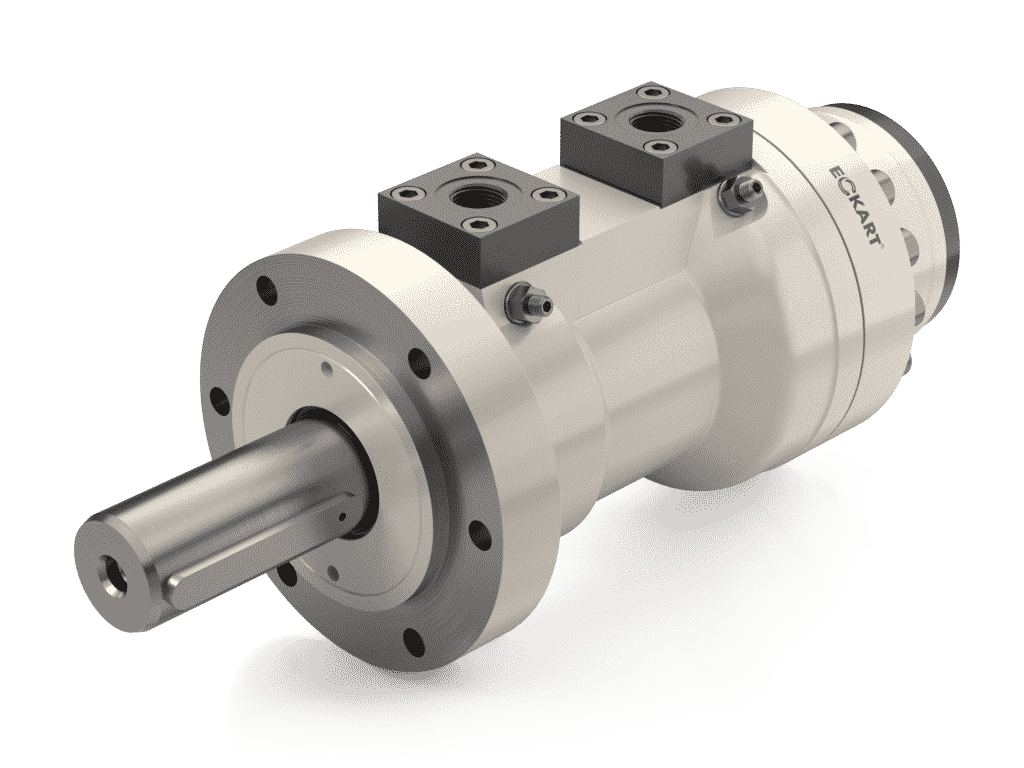
Hydraulic Rotary Actuators in Construction Applications
Today’s construction sites are defined by limited space, complex layouts, and restricted access areas. These conditions often shape how motion solutions are selected. Compact components with precise control remain critical to overall system performance. Rotary actuators have long supported these needs, delivering high power density and precision without fighting for space.
Construction Lifts
The value of rotary actuators is clear in articulating boom lifts, which rely on flexibility and compact design to position workers and tools in hard-to-reach places. These machines often operate in complex environments. On construction sites, this means working around roof trusses and overhead wiring. For industrial plants, this means navigating large presses and furnaces.
Unlike telescopic lifts that extend in a straight line, articulating lifts bend and reach around obstacles, combining long range with precise motion control.
In typical configurations, a boom lift can reach up to 40 to 60 feet vertically and 40 feet horizontally. Larger models can reach ever further, offering a height of up to 150 feet. Combine this with flexible rotation from an actuator, and intricate jobsites become a lot easier to navigate.
Mounted directly to the basket, rotary actuators occupy far less space than conventional linkage or pivot assemblies. The actuator allows the operator to align the basket up to 180° horizontally, exactly where work needs to be done.
For example, when working alongside a building, the wheels and boom can remain aligned in one direction while the basket is oriented against the wall. This lets the operator move steadily along the façade without repositioning the entire machine, improving both jobsite safety and operational efficiency.
Pile Drivers
In a pile driver, the actuator rotates the drive assembly so that each pile (a block of concrete or steel) is oriented correctly before it’s set into the ground. Because the actuator uses a helical spline design, it is highly accurate and creates almost no backlash. The pile goes straight into the ground, exactly in place. This is important as they help support the foundation of major buildings and bridges. Even small misalignment can reduce structural integrity.
Glazing Pane Installation Machines
For glazing applications, rotary actuators provide precise rotation for positioning large and complex loads. In a typical glass handling system, a vacuum attachment secures the pane while the actuator delivers up to 360° of controlled rotation with minimal backlash. Here, operators can maneuver materials into place safely and efficiently. The same setup can be adapted for other fragile or heavy materials such as precast concrete, sheetrock, or plywood.
Why Rotary Actuators Matter for Construction OEMs
Rotary actuators provide OEMS with a straightforward way to improve performance in construction machinery. Their small footprint supports flexible movement in tight work areas, while their helical spline design ensures minimal backlash and precise, repeatable rotation under load. They also improve safety by reducing pinch points found in multi-joint linkages. With all moving parts sealed and lubricated in oil, maintenance is minimal. As construction equipment continues to advance, rotary actuators remain a practical answer to any device needing controlled and consistent rotation.

The 3 Types of Products You’ll See at CONEXPO | Booth #S83340
Actuation
We offer 2 types of compact actuation solutions designed to maximize power density while minimizing space and weight. For construction applications needing to turn or pivot loads, rotary actuators can provide powerful, precise rotation up to 360°. These components are ideal for lifts, cranes, and an assortment of attachments (buckets and grapplers), without the traditional bulky design. Carbon hybrid cylinders reduce weight by up to 70% compared to traditional steel cylinders, without sacrificing strength and durability.
Maintenance
Well-designed hydraulic systems start with reliable control and protection components. We are showcasing low-profile 10,000 psi check valves, ultra-thin butterfly valves, and protective rubber compensators that are all designed for compact installations with high performance under demanding conditions. These solutions help engineers improve system efficiency, protect critical components, and simplify maintenance in space-constrained equipment designs.
Pressure Increase
For applications that demand more force without increasing system size, pressure intensifiers provide a smart solution. Designed to boost hydraulic pressure within existing systems, these components enable higher output performance without redesigning the entire hydraulic circuit. See our most popular model on the floor at CONEXPO. (We’ll even take it apart for you so you can see how it really works!)
See it all in person.
Visit IC-Fluid Power at Booth #S83340 during CONEXPO to explore interactive rotary actuator cutaways, chat with our knowledgeable team, and view our product offering specially curated for the construction industry.
Customize Every Part of Your Rotary Actuator
Sometimes, your application will call for a drop-in replacement with quick shipping and local availability. Sometimes, the solution can’t be found on a shelf. In these scenarios, our manufacturing partners are well equipped to design an actuator that is perfect for your unique application. Below are some of the ways that your actuator can be crafted to your needs.
Butterfly Valves in Horizontal Grinders
Horizontal grinders are essential for construction and demolition sites. These tools help break down concrete, asphalt, wood waste, and mixed debris.
In these rugged environments, hydraulic systems must incorporate fail-safe mechanisms to prevent fluid loss and unplanned downtime. Butterfly valves function as emergency shutoff devices, immediately isolating hydraulic flow if a hose or component fails. By automatically sealing off flow, these valves help protect heavy equipment, maintain jobsite safety, and reduce environmental exposure caused by oil leaks.
This protection is especially important on sites near storm drains, urban waterways, or active infrastructure, where even small spills can mean expensive cleanup efforts and legal repercussions. Just one gallon of hydraulic oil can contaminate up to one million gallons of water. Consider this against a 70-gallon hydraulic reservoir, and the stakes become clear.
Pressure Intensifier Models for Mobile and Construction Industries
In mobile and construction equipment, many hydraulic machines need higher pressure for specific functions. Pressure intensifiers make that possible without needing to upgrade the pump or redesign the HPU. By boosting pressure locally and using existing hydraulic flow, you get pressure only when and where you need it. Below are our 3 most popular intensifier options and how they’re used in mobile and construction industries.
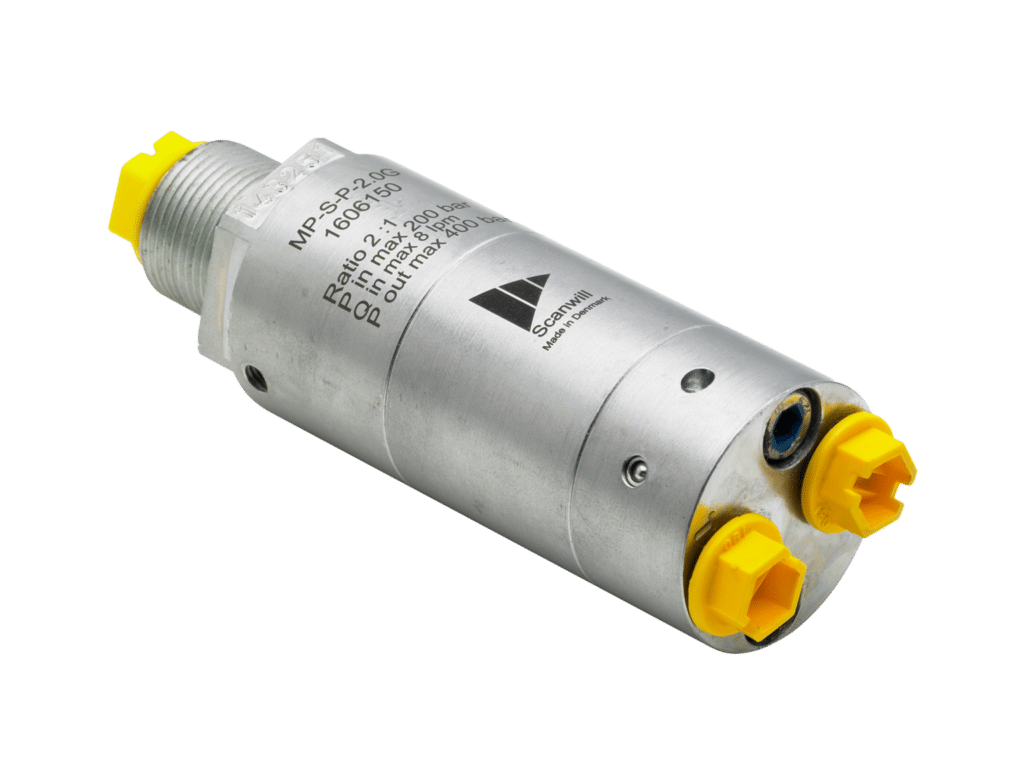
MP-S Series – Low Flow, Compact Applications
Well-suited for small machines and auxiliary tool circuits, the MP-S is ideal where space is limited and flow demands are low.
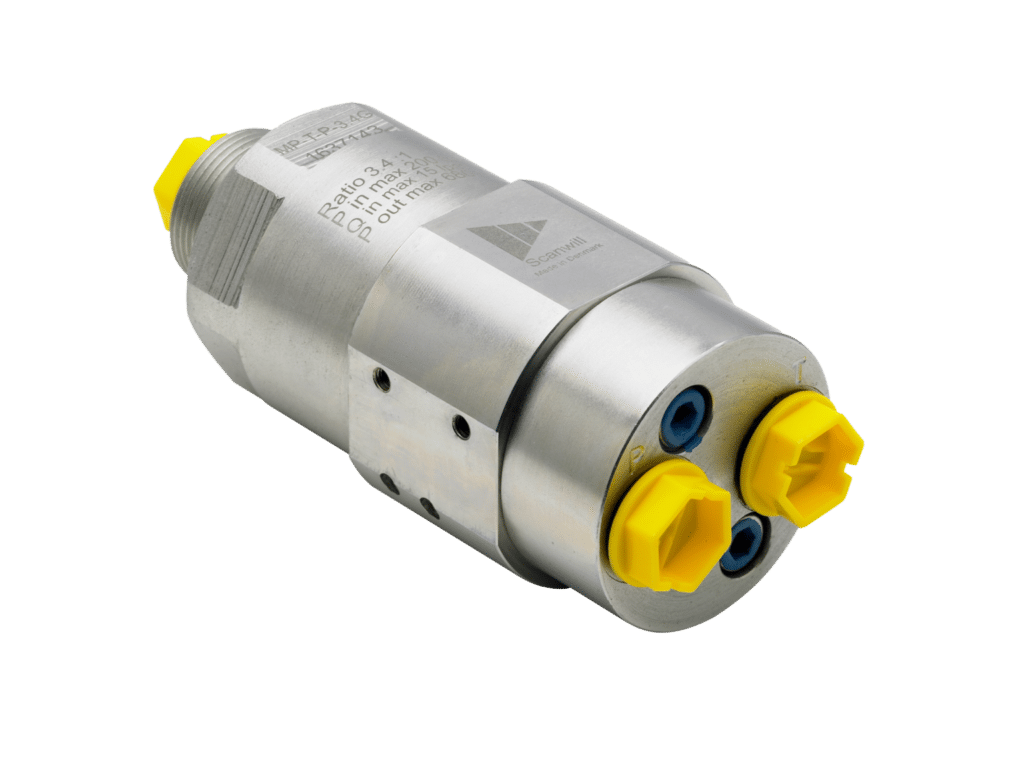
MP-T Series – All-Purpose Solution (Most Popular Intensifier)
The MP-T is the most versatile and widely used option, well-suited for construction and mobile equipment that require short-duration, high-force output rather than continuous flow. The MP-T is also commonly used in industrial and in-plant applications.
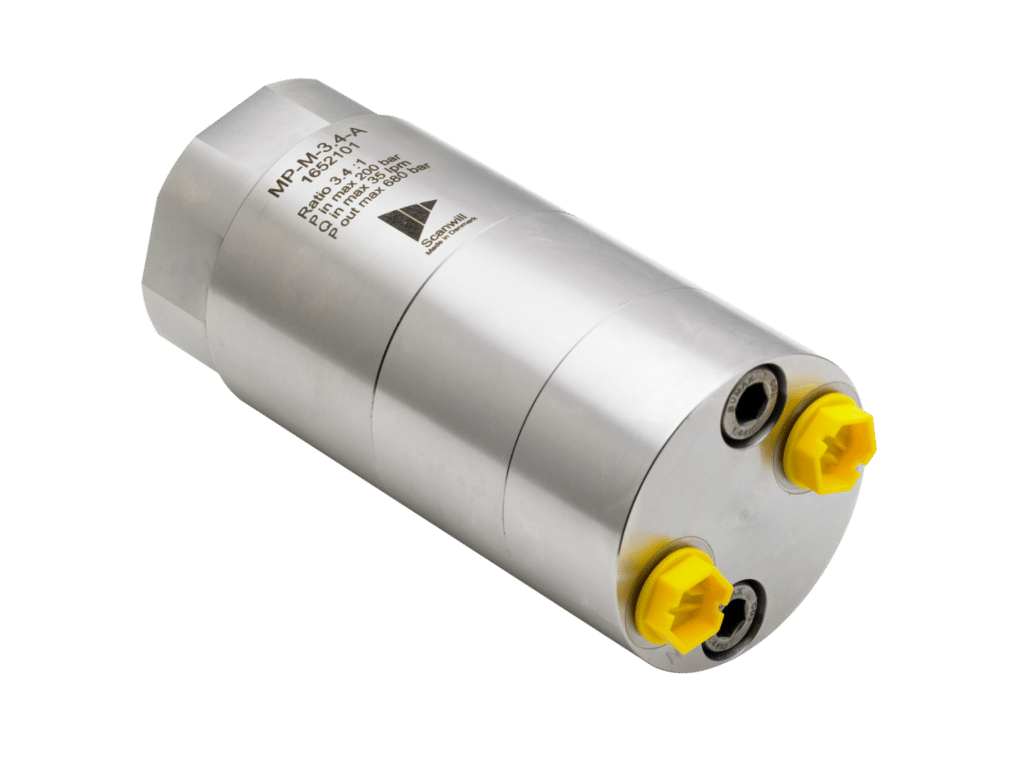
MP-M Series – Higher Flow for Demanding Systems
For larger machines and higher-demand applications, the MP-M provides intensified pressure at higher flow rates.
Bottom line: Pressure intensifiers don’t create power; they use existing power more efficiently. This allows construction and mobile equipment to achieve necessary higher force without larger pumps, additional power units, or system redesigns. The best model for you will depend on both the flow rating and pressure requirements of the application.
MCT Integrates Domin S4 and S6 Pro Into Hydraulic Testing Rig for Better Performance
MCT is an engineering company that designs and builds precision servo-hydraulic test rigs for a variety of applications including automotive, defense, aerospace, and heavy-duty industrial. The following case study highlights two advanced test systems where MCT integrated Domin Servo Valves, both the S4 Pro and the S6 Pro. These integrations resulted in enhanced responsiveness, tighter control tolerances, and improved reliability of test data.
High-Frequency Testing Rig
In one application, Domin S4 Pro valves were incorporated into a bespoke hydraulic test platform designed for high-frequency actuation. The system tested hydrostatic bearing performance with exceptionally high accuracy. Each actuator utilized a Domin valve with a varied flow rate and force output, allowing MCT to test a wider variety of scenarios without compromising control.
Key Performance Figures of the S4 Pro in the MCT High-Frequency Test Rig
Counter Force Test Bench
Another application where MCT utilized Domin valves is in a counterforce actuator test bench: a large-force, long-stroke testing environment where precision is incredibly important. The system incorporated S6 Pro servo valves to deliver stable, reliable control with repeatable force and position control over extended stroke lengths.
System Configuration for the S6 Pro in the MCT Counterforce Actuator Test Bench
Domin Servo Valves for Better Test Results
These projects demonstrate how Domin Valves not only integrate seamlessly into hydraulic test system designs, but how they improve testing conditions for better, more accurate, repeatable data, helping engineers move beyond the constraints of conventional hydraulic control.
Read the entire case study here.