
All Cylinder Customizations, Domin Servo Valve FAQs & Upgrades, and Painted Pressure Intensifiers
April 21, 2026
Customize Every Part of Your Cylinder
Free Virtual Seminar: Hydraulic Actuators for Testing Applications
Upgrade Your Servo Valve for Better Performance
Domin Servo Valves FAQs
NEW Painted Pressure Intensifiers
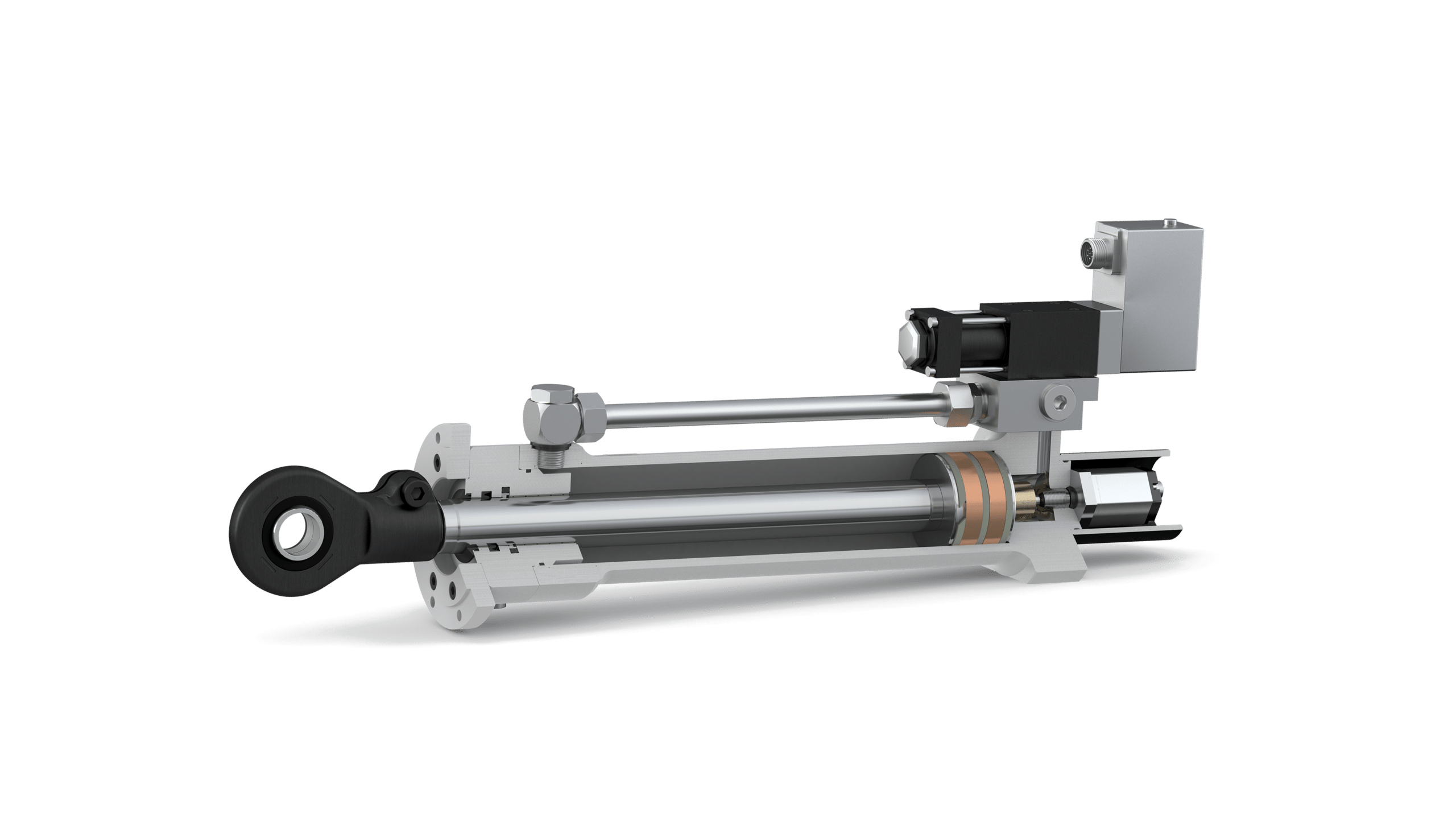
Customize every part of your hydraulic cylinder
Customizing a hydraulic cylinder can be as simple as choosing the bore size and stroke length or as intricate as choosing every single part. At this level, every part of the cylinder can be customized including the material, type, medium, size, sealing, rod coating, mounting, ports, sensors, paint, cushioning, and load-holding options.
1. Materials
The right material determines the cylinder’s strength and lifespan. Some materials offer additional benefits such as significantly lower weight or high corrosion resistance. Below is a sampling of common materials, but any specialty material is possible.
*The main body is made of carbon fiber with the remaining components made from steel, such as the listed steels above.
2. Cylinder Types
The right cylinder for your application depends on what it is being used for and the demands of the operating conditions. We offer single-rod, double-rod, telescopic, tie-rod, and welded cylinders.
3. Mediums
Different mediums are better suited for different applications and are often selected based on the required viscosity, thermal stability, oxidation resistance, lubricity, and water tolerance.
Some of the different mediums used in custom cylinders are pneumatic, mineral oils, fire-resistant fluids, biodegradable oils, and application-specific fluids with unique requirements for industries such as military, aviation, and automotive.
4. Cylinder Size
Different cylinder manufacturers specialize in specific size ranges or capabilities. Some can customize cylinders with bores as small as 0.5 inches, also known as micro-cylinders. Some manufacturers deal with specialized applications in traditional lengths ranging from 50mm to 500mm. Other manufacturers are only limited by cost and material availability, building hydraulic cylinders up to 260 metric tons with 13 ft diameters.
5. Sealing Technologies
The right sealing system ensures proper cylinder performance, efficiency, and service life. Different seal types are designed for specific operating conditions such as pressure, temperature, friction, fluid compatibility, and motion speed. We offer over 60 different sealing configuration types. Below is an overview of common seal types used in hydraulic cylinders, including standard industrial options and specialized/patented configurations only offered by certain manufacturers.
** Includes patented sealing technologies only offered by Hänchen
*** Includes patented sealing technologies only offered by Hunger Hydraulics
6. Rod Coatings
Rod coatings protect piston rods from things like wear, corrosion, micro-scoring, and more to extend the service life of the cylinder. Standard surface treatments and specialized rod coatings are offered.
**** These options are specialized rod coatings offered only by Hunger Hydraulics
7. Mounting Types
A full range of cylinder mounting types is possible, from standard flange fittings to trunnion and pivot designs. Different options are available for cylinder body mounting and piston rod ending mounting. The type of mounting depends on factors such as degrees of freedom, typical force direction, and fixation type.
8. Hydraulic Ports
Hydraulic cylinders can be equipped with a variety of ports, fittings, and mounting surfaces to match control valve standards, pressure ratings, and flow requirements. Common ports include SAE, NPT, metric, and BSP. Ports can be positioned radially, axially, piped, or on a mounting plate, depending on application needs.
Mounting plates allow direct installation of servo or directional control valves, which is selected based on flow capacity and valve type. Standard mounting surfaces support flow rates from 5 to 66 gpm (18–250 lpm) and conform to ISO or DIN specifications. Accessories such as adapters, air filters, or test points can be installed on either side of the cylinder.
9. Sensor Technologies and Data Collection
Sensors can be added for automation to measure and monitor critical changes in systems using Industry 4.0 standards. This allows for real-time data monitoring, predictive maintenance, and closed-loop control, which all contribute to better system reliability and performance. Popular sensor options are:
10. Paint Capabilities
As with many customizations of hydraulics cylinders, both standard and specialty paint options are possible. Standard paint options include unpainted, some form of primer (acrylic, epoxy), or base coatings (1k synthetic epoxy, acrylic paints for general environmental resistance). Specialty paint options offer a higher level of protection and are often used in specific industries that are more susceptible to unique damages or corrosion, including:
11. Cushioning
Cushioning is added to gradually slow the piston as it nears the end of its stroke, protecting the cylinder and connected equipment from impact damage and excessive shock loads. Both standard and advanced cushioning systems with customized orifices are possible.
The following characteristics that can be customized for advanced cushioning systems:
12. Optional Safety and Load-Holding Options
Rod-locking devices (Hänchen’s Ratio Clamp®) provide optional added security for hydraulic cylinders by mechanically locking piston or round rods to hold loads up to 2,000 kN. The device uses spring force to clamp the rod without needing continuous energy and unlocks only when hydraulic pressure is applied, allowing it to function as both a holding mechanism and a safety device. This makes it an efficient way to keep a cylinder in position indefinitely while reducing demand on the HPU (saves money too!)
Learn more about our Hydraulic Cylinders
Free Virtual Seminar: Hydraulic Actuators for Testing Applications
Are you involved in designing or modifying functional/endurance test rigs and interested in exploring the many capabilities of hydraulic actuators? Our partner, Herbert Hänchen GmbH from Germany, is offering a seminar on their hydraulic test actuator in a few weeks!
Date: April 22nd, 2026
Time: 9:00 a.m. until 10:45 a.m. EST
Place: Virtual
Language: English
Seminar goal:
To provide participants with practical, in-depth knowledge regarding hydraulic cylinders for testing applications and their key components.
Seminar content:
Register for the Hydraulic Test Actuator Seminar
Discover Domin’s plug-and-play replacements for leading brands
Our valves fit industry-standard port patterns, like S01, NG06, and NG10, so your upgrade is fast and effortless. Adapter plates cover the rest. Domin offers direct upgrades for Moog, Woodward, Parker, Bosch Rexroth, Atos, and Star. The chart below shows the most common upgrades!
Drop-ins with MORE benefits
Our Domin valves aren’t just drop-in replacements. Each model offers immediate performance gains such as better efficiency, faster response, and higher bandwidth.
Popular Brand Upgrades
|
S4 Pro (S01) |
S6 Pro (NG06) |
S10 Pro (NG10) |
S12 Pro (NG16) |
|
|
Moog |
D633 |
D633, D634, G761, D662 |
D661, D634, G631, D662 |
– |
|
Woodward |
27A, 27B |
27B, 27C, 27E |
27E, 27G |
– |
|
Parker |
D1FP |
D1FP, D1FB, D3FP |
D3FP, D3FB, DY45 |
D4FP |
|
Bosch Rexroth |
4WRPEH 6 |
4WRPEH 6, 4WRPEH 10, 4WREE 6 |
4WRPEH 10, 4WRLE 10, 4WREE 10 |
4WRLE 16 |

What you should know about Domin Servo Valves
Below are some questions we often get about our Domin Servo Valves:
1. How are Domin valves different than traditional valves?
Domin valves blend the speed of servo valves with the durability of proportional valves. This hybrid design gives you fast response, strong reliability, and a lower overall weight.
2. What keeps Domin Servo Valves lightweight?
Domin uses additive manufacturing to eliminate the heavy, complex pilot stage seen in standard servo valves. The result is a lighter valve that still delivers fast response and precise control.
3. How do we achieve 1-2 day lead times?
Domin valves are kept in stock at IC-Fluid Power’s warehouse in Toledo, Ohio and shipped the same day for U.S. customers. With Lead Time Zero, we’re able to get you servo valves in just a day versus 12-16 weeks.
Learn more about our Domin Servo Valves

ScanWill Pressure Intensifiers are now available with paint
We’re excited to share our latest addition to our product range, a painted version of our intensifier models. Whether you’re looking to reduce costs or upgrade performance, this new variant delivers without compromise.